
I’ve Spent 6 Years Testing Brand Strategies — Here’s What Actually Works in 2026

Let me save you some time.
There is so much advice out there about how to build a personal brand. Lead with your story. Show your values. Stay consistent. Pick three content pillars. Get a logo suite. Build a color palette that “speaks to your audience” (there’s truth in this one). Post on LinkedIn. No, post on Instagram. Actually, Threads is having a moment. Your headshots are the priority. Your website is the priority. Your email list is the priority.
It’s a lot. And most of it is repeated so confidently by so many people that it’s easy to assume it all must be true.
I’ve spent the last six years doing brand and web design work — not just for one type of client, but for consultants, nonprofit leaders, thought leaders, and service providers who’ve been running their businesses long enough to know the difference between advice that sounds good and advice that actually does something. And I can tell you: a surprising amount of what gets passed around as brand strategy is either incomplete, out of context, or just plain overrated.
So let’s talk about what actually moves the needle. Not in theory. In practice.
The biggest myth in personal branding (and the one that costs the most)
Here’s the one I run into constantly: if your brand isn’t working, you need a rebrand.
New logo. New colors. New website. Fresh start. Wipe the slate and begin again, presumably with a better aesthetic sensibility this time.
And I get it sometimes a visual refresh is genuinely the right move. If your brand was built five years ago when your business looked completely different, or if the way you show up visually no longer reflects where you are, updating those assets makes sense. I’m not anti-rebrand.
But the mistake is thinking that new visuals will fix what is actually a clarity problem.
I’ve worked with clients who came to me after investing in gorgeous brand identities that weren’t converting. The colors were intentional and the logo was clean and memorable. And still their website wasn’t generating inquiries, their proposals weren’t landing, and referrals were coming through with the wrong expectations.
What actually moves the needle: positioning before aesthetics
Before any design work — before we touch a color or select a font or build a single page — the most important question is: who is this brand actually for, and what does it need to make them do?
Not in a vague, “it’s for established founders who value quality” sense. Specifically:
What does this person believe before they land on your site?
What do they need to understand, feel, or be convinced of in order to take the next step?
What objection sits between them and a yes?
When these questions are answered clearly, the design work has somewhere to go. Think about it: the copy has a job, the website has a conversion logic underneath it and everything is aligned.
That’s why the founders I’ve watched build brands that actually generate opportunities — the ones whose websites get shared, whose proposals close faster, whose referrals come in pre-sold — are almost never the ones with the most elaborate visual identities. They’re the ones who are the clearest about what they do, who it’s for, and what makes it worth the investment.
Clarity converts isn’t just a repeated phrase, it’s truth. The aesthetics just reinforce your vision.
What I stopped recommending (and why)
I used to follow the industry-standard advice pretty closely. Establish your brand before your website. Nail down your core values. Build out your visual identity system. Then build your site.
I still believe in strategy before design, always. But I’ve gotten a lot more specific about what “strategy” actually means in this context, because there’s a version of brand strategy work that stays so theoretical it never does anything useful.
I stopped recommending multi-week brand discovery processes that produce a beautiful brand guide and a clearly defined brand voice... that then get handed to a web designer who builds a generic site anyway.
I stopped recommending color psychology deep-dives for clients whose real problem is that nobody visiting their site understands what they do within the first ten seconds.
I stopped recommending three-month brand overhauls for clients who needed a website that converts in the next quarter.
What I recommend instead: a tighter, strategy-first approach that gets you from positioning clarity to live website without the detours. Design Sprints to be exact, a 2-week process to help you go from the best kept secret to industry expert without the 6-month timeline.
What’s actually working in 2026
Here’s what I’m seeing make a real difference for established founders right now.
A clear, specific point of view.
Not generic. Not safe. Not “results-driven with a client-centric approach.” A perspective on how you work, why it works, and what you believe most of your industry has wrong. The brands that cut through noise in 2026 are the ones that take a stance.
A website built around one primary conversion action.
Not a site that tries to do everything — introduce the brand, explain the methodology, feature every service, capture the email, tell the full story. One clear thing you want the right person to do when they land there. Everything else supports that.
Messaging that speaks to where the client already is.
Not who you want to attract in theory, but the specific person who’s already looking for what you do and needs to be convinced that you’re the one to deliver it. The more specifically you can speak to their actual situation, the faster trust builds.
A digital presence that matches the room you walk into.
This is the one I come back to the most. I’ve worked with consultants who command five-figure contracts, nonprofit leaders who manage multi-million dollar programs, and thought leaders who are regularly on stages and in boardrooms — whose websites looked like they were built in 2017 and never revisited. The gap between how they show up in person and how they show up online is costing them opportunities they never even find out about.
Your brand is often the first impression you don’t get to be present for. It needs to do the work before you ever get on a call.
The uncomfortable part
Here’s what I wish someone had told me earlier in this work: brand strategy isn’t a phase you complete and then move past, it’s ongoing.
Your business evolves, your positioning sharpens and the clients you want to attract shift as you move into new rooms. That brand that was perfectly aligned two years ago can start to create friction in ways you don’t immediately recognize until you notice that your website traffic isn’t converting the way it used to, or your referrals keep coming in slightly off-brief, or the inquiry form keeps attracting people who aren’t actually a fit.
Those aren’t random but instead signals. And they’re easier to address before they become patterns in your business.
The founders who treat their brand as infrastructure — something worth auditing, updating, and building toward the next level — are the ones who aren’t starting over every few years they’re constantly reiterating and quick to test what works.
What to focus on right now
Before you think about aesthetics, get clear on positioning. Who is your brand for, specifically? What does it need to communicate, and to whom, and in order to make them do what? If you can’t answer those questions clearly, that’s the work that needs to happen first.
Then look at your website. Not at how it looks but at what it does.
Does a first-time visitor understand within ten seconds who you help and what happens next?
Does the experience of moving through the site build confidence and move them toward a decision?
Does it reflect the level of work you actually do?
If any of those answers are “not really,” that’s where the gap is. And that’s where we can start.

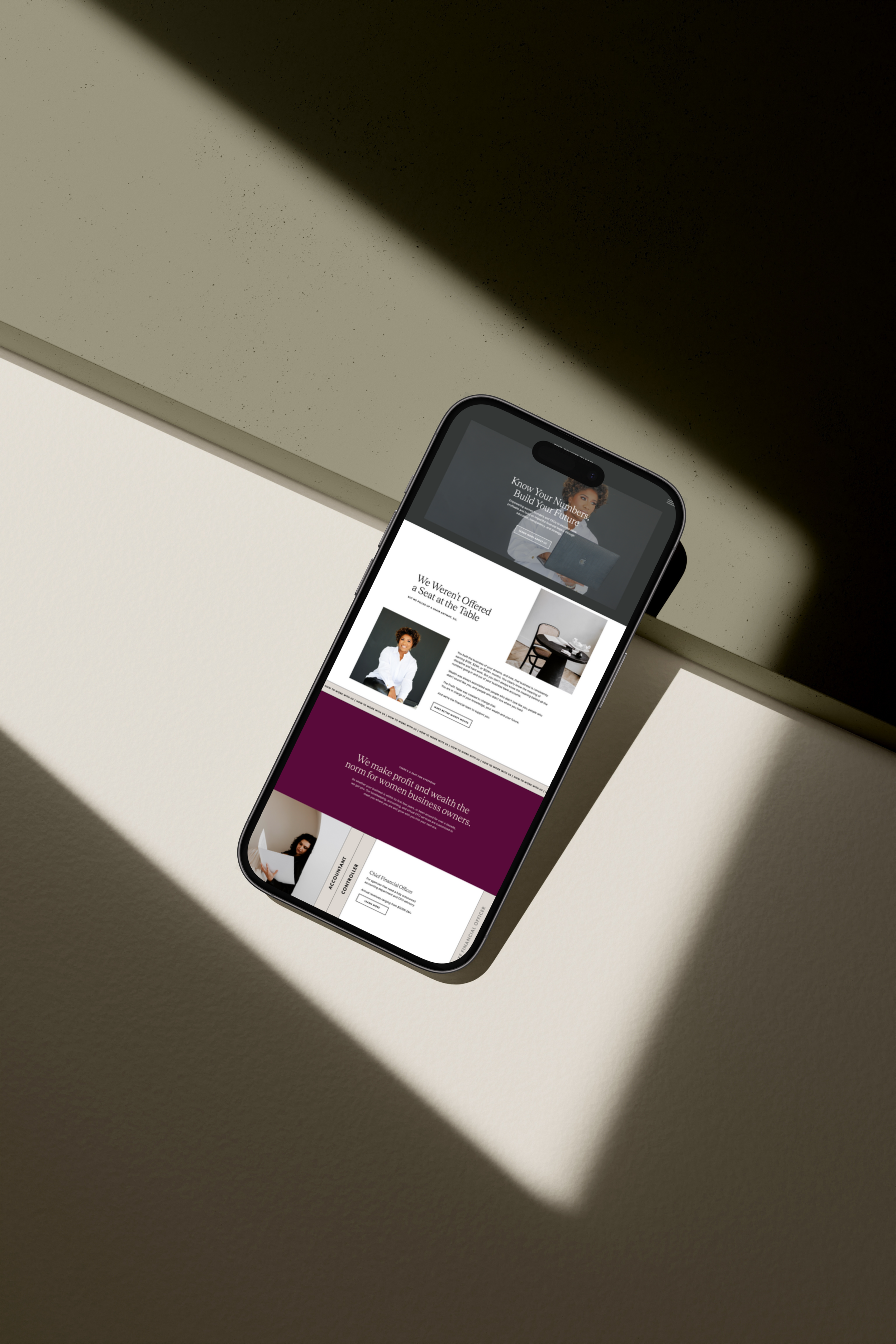

Wondering if website copy needs to come before design? The answer is a resounding yes. Your copy lays the groundwork for a cohesive, user-friendly site that speaks directly to your audience. Dive into why words should lead the way in your website project.